Wallace Stevens gives me words to think and feel and speak the sky.
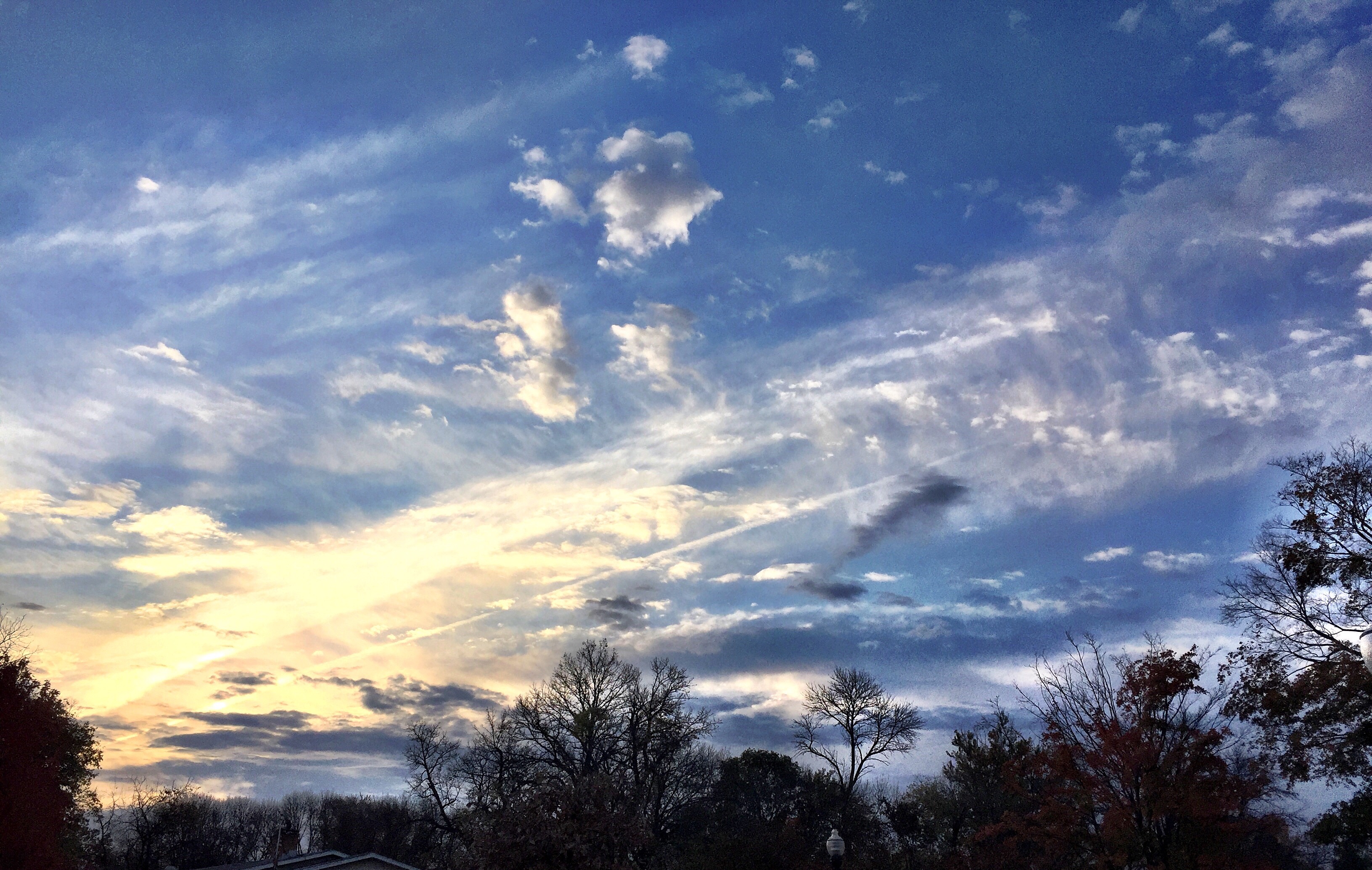
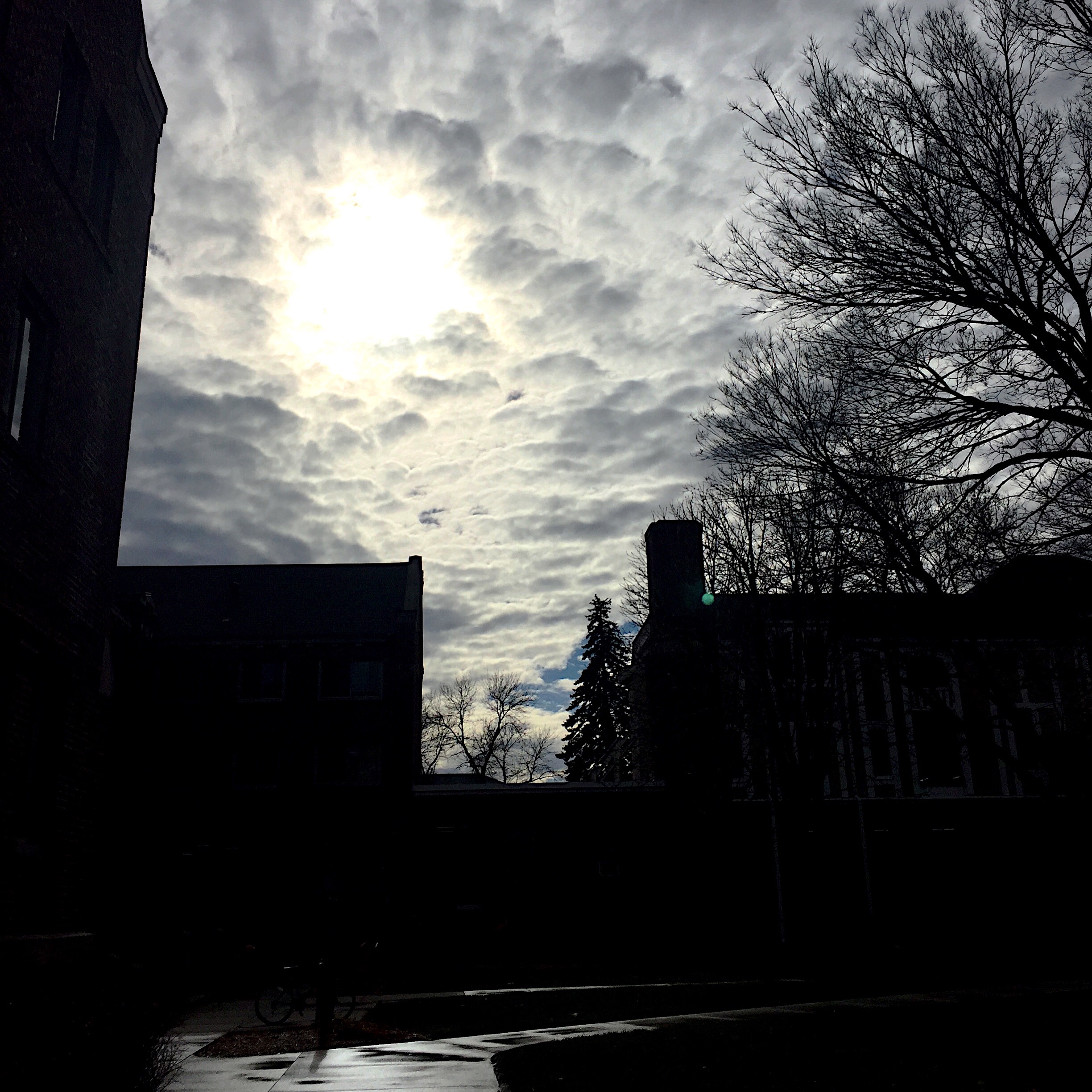
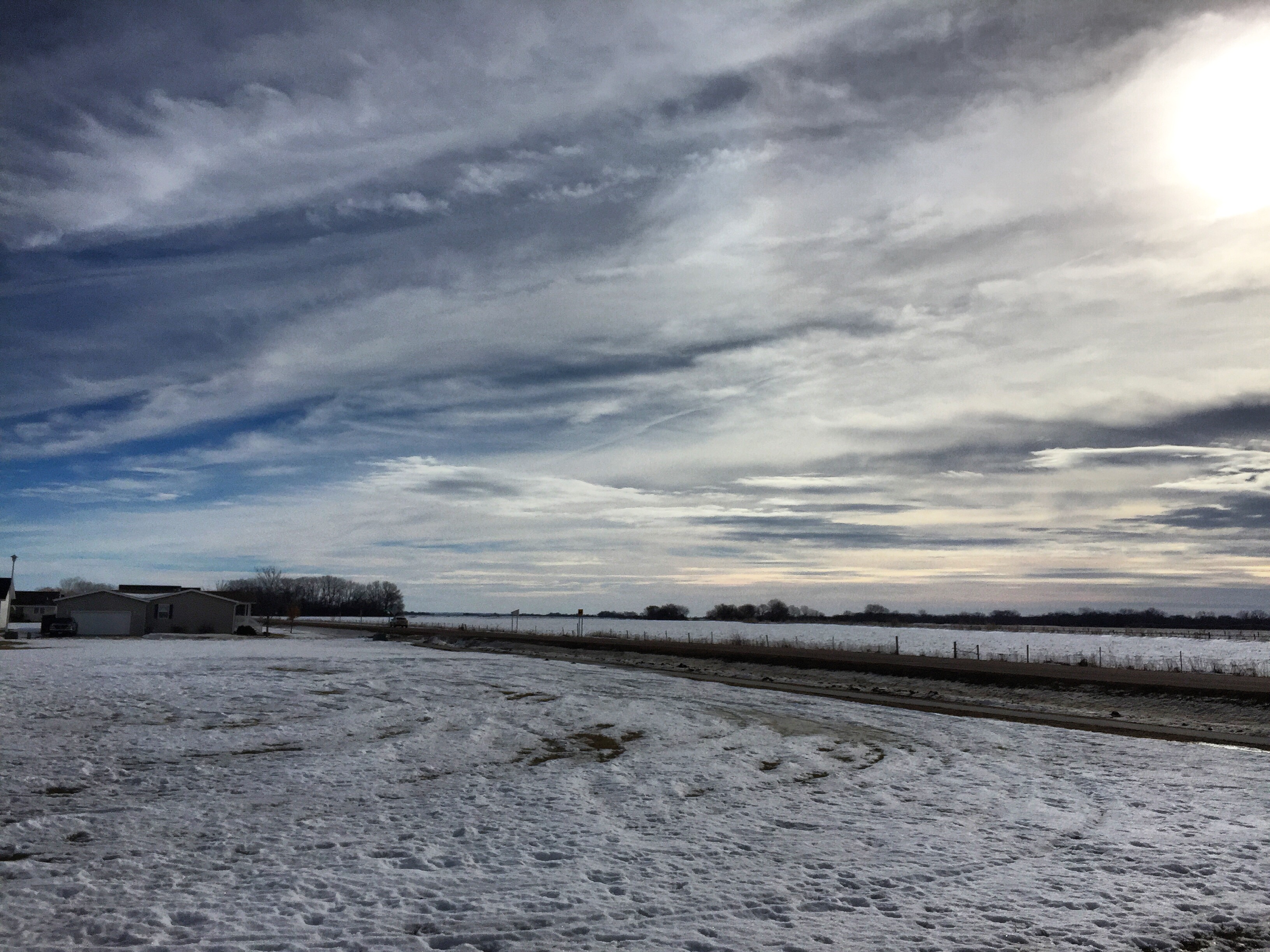
Part of my survival strategy thus far in South Dakota—”survival” in the sense of living alone for months and months, separated from my partner—part of my survival has been to record (when I can) the captivating sky. Here are just a few images, captioned with lines stolen—without care of their context—from The Collected Poems (1954):

Can one—and how can one—grow old otherwise?
Listen:
Song of Fixed Accord
Rou-cou spoke the dove,
Like the sooth lord of sorrow,
Of sooth love and sorrow,
And hail-bow, hail-bow,
To this morrow.
She lay upon the roof,
A little wet of wing and woe,
And she rou-ed there,
Softly she piped among the suns
And their ordinary glare,
The sun of five, the sun of six,
Their ordinariness,
And the ordinariness of seven,
Which she accepted,
Like a fixed heaven,
Not subject to change . . .
Day’s invisible beginner,
The lord of love and of sooth sorrow,
Lay on the roof
And made much within her. (The Collected Poems 519–20)
Stevens’s use of ellipses in these last poems is breathtaking. One encounters them in “One of the Inhabitants of the West,” “Madame La Fleurie,” “To an Old Philosopher in Rome,” “Vacancy in the Park,” “Looking across the Fields and Watching the Birds Fly,” “Long and Sluggish Lines,” “Final Soliloquy of the Interior Paramour,” “The Rock,” “St. Armorer’s Church from the Outside,” “Note on Moonlight,” “The River of Rivers in Connecticut,” and “Not Ideas about the Thing but the Thing Itself.” While this strategy of punctuation might have a general function in these poems—the placement of a pause at the beginning, middle, or end of a thought or line—the specific effect of the ellipses in each poem is singular, particular. In “Song of Fixed Accord” it reorients us, gives us room to feel the “ordinariness” and regularity of “woe” and “sorrow” and “love” at 5am, 6am, 7am (or at fifty? sixty? seventy?). But the following line, “Day’s invisible beginner,” also reminds us that the speaker cannot see “the dove”; he (and we) only hear it, cut off (“. . .”?) from its resting place (its home?) “on the roof” (of our home?). The final line holds out some bare hope (as so many of these late poems do) that the act of making or creating or imagining provides one not so much with consolation in the face and fact of aging and ending but, rather, with sensuous joys and surprising stimulations, intensified as so much more of one’s life passes into the past.
And what a strange and delicate and touching use of the word “sooth.”
In returning to Stevens, I’ve also found I cannot uncouple my love of his writing from my love of Helen Vendler. Despite the vastness of the scholarly literature on Stevens (formal, biographical, historical, theoretical, philosophical, and political), none of it quite touches me or strums my poetic sensibilities the way Vender’s writing can. “An Ordinary Evening in New Haven is . . . almost unremittingly minimal,” she writes, “and over and over again threatens to die of its own starvation” (On Extended Wings 270). Her reading of this long poem, composed between 1949 and 1950, tracks “[t]he impossible task” of “account[ing] . . . for a depression which is overwhelmingly physical—the metabolic depletion in age of the body’s responses” (271). So perhaps it is here that I became interested in Stevens and aging.
And now here I am, in South Dakota, still interested in Stevens, returning to and relishing Vendler’s criticism, still interested in aging, but with a new fascination for the sublimities of skies.
Reading on . . .

 Sketching a Present
Leave a reply to Christopher Jenks Cancel reply